

How To Create Shortcut For Jupyter Notebook
Jupyter Notebook Shortcuts


What is Jupyter Notebook?
Jupyter Notebook is widely used for data analysis. I started to learn Data Science 2–3 months ago and I used this tool to explore some datasets (a collection of data). It's awesome!
Let's see the definition from the docs.
The notebooks documents are documents produced by the Jupyter Notebook App, which can contain both code (e.g. Python) and rich text elements (paragraphs, equations, links, etc..).
The Jupyter Notebook App is a client-server application that allows editing and running notebook documents by a browser.
Here you can find more detailed information if you want to.
Shortcuts
As a developer, I like to use shortcuts and snippets as much as I can. They just make writing code a lot easier and faster. I like to follow one rule:
If you start doing some action with the mouse, stop and think if there is a shortcut. If there is a one - use it.
When I started usin g Jupyter Notebook I didn't know that there are shortcuts for this tool. Several times, I changed my cell type from code to markdown and I didn't know how. As you can guess this caused me a lot of headache. One day I just saw that there is a Help > Keyboard Shortcuts link in the menu bar. To my surprise, it turned out that Jupyter Notebook has a ton of shortcuts.
In this article, I'll show you my favorite ones. Note that the shortcuts are for Windows and Linux users. Anyway, for the Mac users, they're different buttons for Ctrl, Shift, and Alt:
-
Ctrl: command key⌘ -
Shift: Shift⇧ -
Alt: option⌥
First, we need to know that they are 2 modes in the Jupyter Notebook App: command mode and edit mode. I'll start with the shortcuts shared between the two modes.
Shortcuts in both modes:
-
Shift + Enterrun the current cell, select below -
Ctrl + Enterrun selected cells -
Alt + Enterrun the current cell, insert below -
Ctrl + Ssave and checkpoint
While in command mode (press Esc to activate):
-
Entertake you into edit mode -
Hshow all shortcuts -
Upselect cell above -
Downselect cell below -
Shift + Upextend selected cells above -
Shift + Downextend selected cells below -
Ainsert cell above -
Binsert cell below -
Xcut selected cells -
Ccopy selected cells -
Vpaste cells below -
Shift + Vpaste cells above -
D, D (press the key twice)delete selected cells -
Zundo cell deletion -
SSave and Checkpoint -
Ychange the cell type to Code -
Mchange the cell type to Markdown -
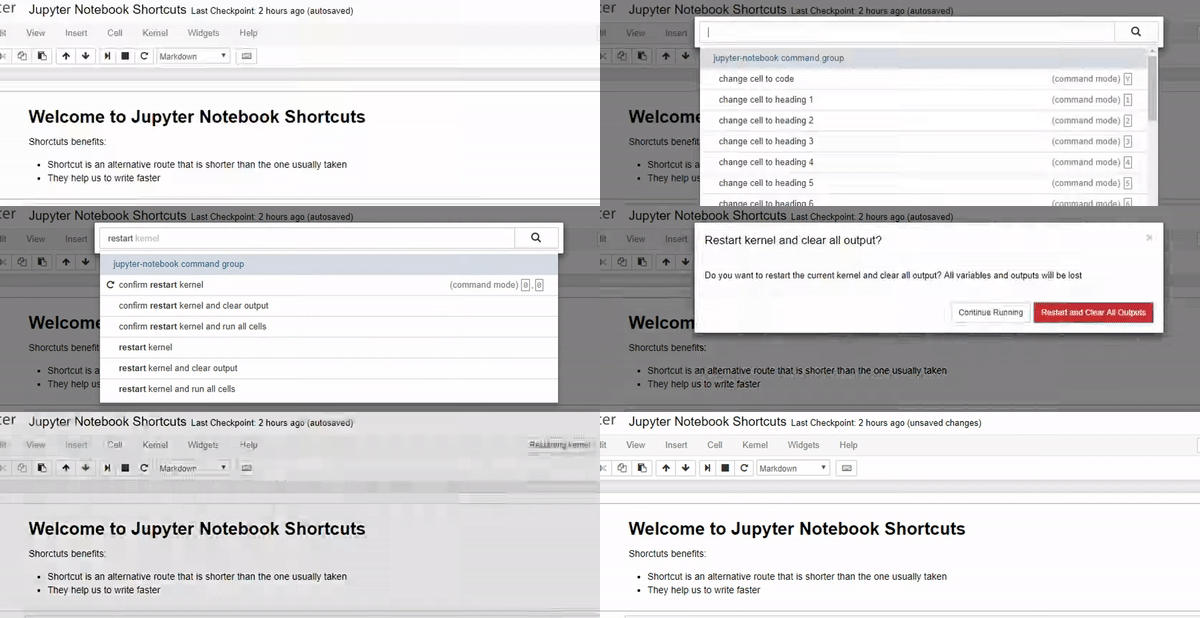
Popen the command palette.
This dialog helps you run any command by name. It's really useful if you don't know some shortcut or when you don't have a shortcut for the wanted command.
-
Shift + Spacescroll notebook up -
Spacescroll notebook down
While in edit mode (pressEnter to activate)
-
Esctake you into command mode -
Tabcode completion or indent -
Shift + Tabtooltip -
Ctrl + ]indent -
Ctrl + [dedent -
Ctrl + Aselect all -
Ctrl + Zundo -
Ctrl + Shift + ZorCtrl + Yredo -
Ctrl + Homego to cell start -
Ctrl + Endgo to cell end -
Ctrl + Leftgo one word left -
Ctrl + Rightgo one word right -
Ctrl + Shift + Popen the command palette -
Downmove cursor down -
Upmove cursor up
These are the shortcuts I use in my daily work. If you still need something that is not mentioned here you can find it in the keyboard shortcuts dialog (H). You can also edit existing or add more shortcuts from the Help > Edit Keyboard Shortcuts link in the menu bar. Clicking the link will open a dialog. At the bottom of it there are rules for adding or editing shortcuts. You need to use hyphens - to represent keys that should be pressed at the same time.
For example, I added a shortcut Ctrl-R for the restart kernel and run all cells command.
Other Blog Posts by Me
- Python Basics for Data Science
- Data Science with Python: Intro to Data Visualization with Matplotlib
- Data Science with Python: Intro to Loading and Subsetting/Filtering Data with pandas
- Introduction to Natural Language Processing for Text
Here is my LinkedIn profile in case you want to be connected with me.
Newsletter
If you want to be notified when I post a new blog post you can subscribe to my newsletter.
Final Words
Thank you for the read, if you like this post please hold the clap button. Also, I'll be happy to share your feedback.
How To Create Shortcut For Jupyter Notebook
Source: https://towardsdatascience.com/jypyter-notebook-shortcuts-bf0101a98330
Posted by: deeringbefiscure.blogspot.com
0 Response to "How To Create Shortcut For Jupyter Notebook"
Post a Comment