

what statistics are needed to draw a box plot?
Descriptive Statistics
Box Plots
Box plots (also called box-and-whisker plots or box-whisker plots) give a practiced graphical image of the concentration of the information. They too testify how far the extreme values are from nigh of the data. A box plot is constructed from v values: the minimum value, the start quartile, the median, the third quartile, and the maximum value. We use these values to compare how close other data values are to them.
To construct a box plot, use a horizontal or vertical number line and a rectangular box. The smallest and largest data values label the endpoints of the axis. The beginning quartile marks i end of the box and the third quartile marks the other cease of the box. Approximately the centre 50 pct of the data autumn within the box. The "whiskers" extend from the ends of the box to the smallest and largest information values. The median or second quartile can exist between the first and third quartiles, or it can be one, or the other, or both. The box plot gives a good, quick picture of the data.
Notation
You may come across box-and-whisker plots that take dots mark outlier values. In those cases, the whiskers are not extending to the minimum and maximum values.
Consider, again, this dataset.
ane 1 ii two iv half-dozen 6.8 seven.2 8 8.3 9 10 x 11.v
The first quartile is ii, the median is seven, and the 3rd quartile is nine. The smallest value is ane, and the largest value is 11.5. The post-obit image shows the constructed box plot.
NOTE
Encounter the calculator instructions on the TI web site or in the appendix.

The 2 whiskers extend from the showtime quartile to the smallest value and from the third quartile to the largest value. The median is shown with a dashed line.
NOTE
It is important to start a box plot with a scaled number line. Otherwise the box plot may not be useful.
The following data are the heights of 40 students in a statistics class.
59 60 61 62 62 63 63 64 64 64 65 65 65 65 65 65 65 65 65 66 66 67 67 68 68 69 lxx seventy 70 70 lxx 71 71 72 72 73 74 74 75 77
Construct a box plot with the following properties; the reckoner intructions for the minimum and maximum values equally well as the quartiles follow the example.
- Minimum value = 59
- Maximum value = 77
- Q1: First quartile = 64.5
- Qii: Second quartile or median= 66
- Q3: Third quartile = 70

- Each quarter has approximately 25% of the data.
- The spreads of the iv quarters are 64.5 – 59 = v.5 (first quarter), 66 – 64.v = 1.5 (second quarter), lxx – 66 = 4 (third quarter), and 77 – lxx = 7 (fourth quarter). And then, the second quarter has the smallest spread and the 4th quarter has the largest spread.
- Range = maximum value – the minimum value = 77 – 59 = 18
- Interquartile Range: IQR = Qiii – Qone = 70 – 64.five = 5.v.
- The interval 59–65 has more than than 25% of the data so it has more data in it than the interval 66 through 70 which has 25% of the data.
- The middle 50% (heart half) of the data has a range of 5.5 inches.
To find the minimum, maximum, and quartiles:
Enter information into the list editor (Pres STAT 1:EDIT). If you lot need to clear the listing, pointer upwardly to the name L1, press CLEAR, and then arrow downwardly.
Put the data values into the list L1.
Press STAT and arrow to CALC. Press 1:1-VarStats. Enter L1.
Press ENTER.
Employ the down and up arrow keys to curl.
Smallest value = 59.
Largest value = 77.
Q 1: First quartile = 64.v.
Q 2: 2nd quartile or median = 66.
Q 3: Tertiary quartile = 70.
To construct the box plot:
Press four:Plotsoff. Printing ENTER.
Arrow down and then use the right arrow key to go to the 5th film, which is the box plot. Press ENTER.
Arrow downwards to Xlist: Press 2nd ane for L1
Pointer downwardly to Freq: Press ALPHA. Press one.
Press Zoom. Printing 9: ZoomStat.
Press TRACE, and use the arrow keys to examine the box plot.
Try It
The following information are the number of pages in twoscore books on a shelf. Construct a box plot using a graphing calculator, and country the interquartile range.
136 140 178 190 205 215 217 218 232 234 240 255 270 275 290 301 303 315 317 318 326 333 343 349 360 369 377 388 391 392 398 400 402 405 408 422 429 450 475 512
For some sets of data, some of the largest value, smallest value, showtime quartile, median, and third quartile may exist the same. For instance, you might have a data set in which the median and the third quartile are the same. In this instance, the diagram would not have a dotted line inside the box displaying the median. The right side of the box would display both the third quartile and the median. For case, if the smallest value and the beginning quartile were both ane, the median and the third quartile were both five, and the largest value was 7, the box plot would wait like:
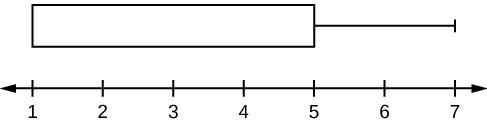
In this example, at least 25% of the values are equal to one. 20-five percentage of the values are between ane and v, inclusive. At least 25% of the values are equal to v. The meridian 25% of the values fall between five and seven, inclusive.
Test scores for a college statistics class held during the mean solar day are:
99 56 78 55.5 32 90 80 81 56 59 45 77 84.five 84 70 72 68 32 79 90
Test scores for a college statistics class held during the evening are:
98 78 68 83 81 89 88 76 65 45 98 90 80 84.5 85 79 78 98 90 79 81 25.5
- Find the smallest and largest values, the median, and the beginning and third quartile for the twenty-four hours class.
- Observe the smallest and largest values, the median, and the first and third quartile for the night grade.
- For each data set, what pct of the information is between the smallest value and the start quartile? the first quartile and the median? the median and the tertiary quartile? the third quartile and the largest value? What percentage of the data is between the beginning quartile and the largest value?
- Create a box plot for each set of data. Use one number line for both box plots.
- Which box plot has the widest spread for the centre l% of the data (the information between the first and third quartiles)? What does this mean for that fix of data in comparison to the other set of data?
-
- Min = 32
- Q 1 = 56
- Thou = 74.5
- Q 3 = 82.five
- Max = 99
-
- Min = 25.five
- Q ane = 78
- Chiliad = 81
- Q 3 = 89
- Max = 98
- Day class: At that place are six information values ranging from 32 to 56: 30%. There are six data values ranging from 56 to 74.5: 30%. There are five data values ranging from 74.v to 82.5: 25%. At that place are v data values ranging from 82.5 to 99: 25%. There are xvi data values between the first quartile, 56, and the largest value, 99: 75%. Night class:
-
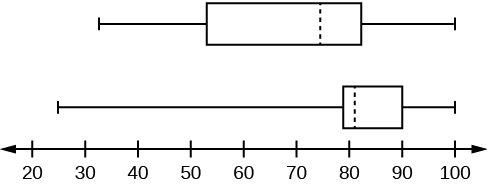
- The first data gear up has the wider spread for the center l% of the data. The IQR for the first data prepare is greater than the IQR for the 2d set. This means that at that place is more than variability in the middle 50% of the beginning data set.
Try It
The post-obit information ready shows the heights in inches for the boys in a grade of 40 students.
66; 66; 67; 67; 68; 68; 68; 68; 68; 69; 69; 69; lxx; 71; 72; 72; 72; 73; 73; 74
The following data fix shows the heights in inches for the girls in a class of twoscore students.
61; 61; 62; 62; 63; 63; 63; 65; 65; 65; 66; 66; 66; 67; 68; 68; 68; 69; 69; 69
Construct a box plot using a graphing calculator for each information set, and land which box plot has the wider spread for the middle 50% of the data.
Graph a box-and-whisker plot for the information values shown.
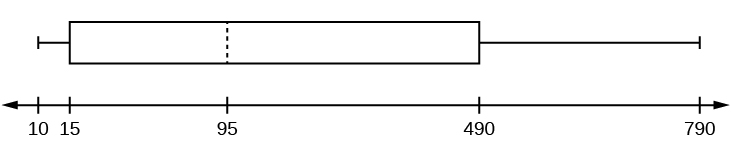
10 10 10 15 35 75 90 95 100 175 420 490 515 515 790
The five numbers used to create a box-and-whisker plot are:
- Min: 10
- Q 1: 15
- Med: 95
- Q 3: 490
- Max: 790
The following graph shows the box-and-whisker plot.
Effort It
Follow the steps y'all used to graph a box-and-whisker plot for the information values shown.
0 5 v 15 thirty thirty 45 50 50 threescore 75 110 140 240 330
Affiliate Review
Box plots are a type of graph that can help visually organize data. To graph a box plot the post-obit information points must be calculated: the minimum value, the first quartile, the median, the third quartile, and the maximum value. Once the box plot is graphed, y'all tin can display and compare distributions of data.
Utilise the following information to respond the next two exercises. Threescore-five randomly selected car salespersons were asked the number of cars they more often than not sell in ane calendar week. 14 people answered that they generally sell three cars; nineteen generally sell four cars; twelve generally sell five cars; nine generally sell six cars; 11 more often than not sell 7 cars.
Construct a box plot beneath. Use a ruler to measure and scale accurately.
Looking at your box plot, does it appear that the data are full-bodied together, spread out evenly, or full-bodied in some areas, simply non in others? How can y'all tell?
More than 25% of salespersons sell iv cars in a typical week. You can see this concentration in the box plot because the first quartile is equal to the median. The top 25% and the bottom 25% are spread out evenly; the whiskers take the same length.
Homework
In a survey of 20-year-olds in Mainland china, Germany, and the United states, people were asked the number of strange countries they had visited in their lifetime. The post-obit box plots brandish the results.
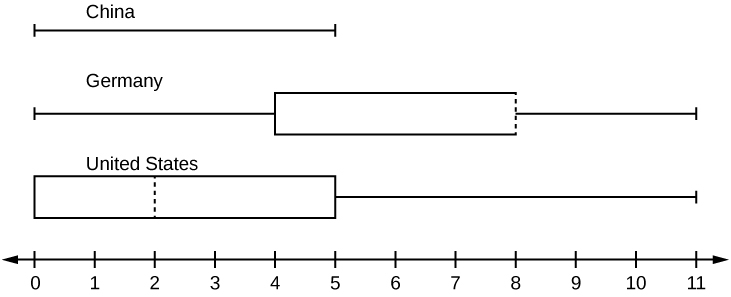
- In complete sentences, describe what the shape of each box plot implies nearly the distribution of the data collected.
- Have more than Americans or more Germans surveyed been to over eight foreign countries?
- Compare the three box plots. What do they imply about the foreign travel of twenty-yr-quondam residents of the three countries when compared to each other?
Given the post-obit box plot, reply the questions.

- Think of an case (in words) where the data might fit into the above box plot. In 2–5 sentences, write downwardly the example.
- What does it mean to have the showtime and second quartiles so shut together, while the second to third quartiles are far apart?
- Answers will vary. Possible reply: State University conducted a survey to come across how involved its students are in community service. The box plot shows the number of community service hours logged past participants over the past year.
- Because the start and 2nd quartiles are close, the information in this quarter is very similar. At that place is not much variation in the values. The data in the third quarter is much more variable, or spread out. This is articulate considering the second quartile is then far away from the 3rd quartile.
Given the following box plots, answer the questions.
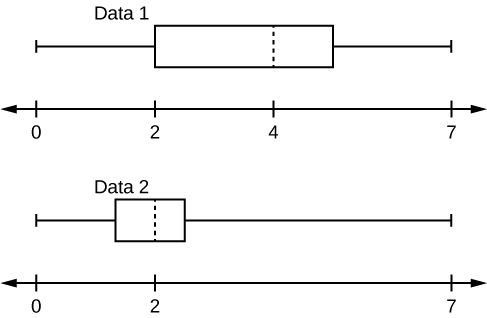
- In consummate sentences, explain why each statement is false.
- Data 1 has more information values above two than Data two has in a higher place two.
- The information sets cannot have the same mode.
- For Data 1, in that location are more data values below four than in that location are above 4.
- For which grouping, Data i or Data two, is the value of "7" more likely to be an outlier? Explicate why in complete sentences.
A survey was conducted of 130 purchasers of new BMW 3 serial cars, 130 purchasers of new BMW 5 series cars, and 130 purchasers of new BMW 7 serial cars. In it, people were asked the age they were when they purchased their car. The post-obit box plots display the results.
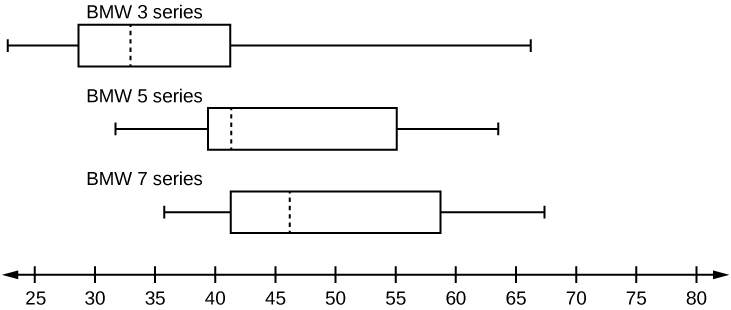
- In complete sentences, describe what the shape of each box plot implies virtually the distribution of the data nerveless for that car series.
- Which group is most probable to have an outlier? Explicate how you determined that.
- Compare the three box plots. What do they imply about the age of purchasing a BMW from the serial when compared to each other?
- Expect at the BMW 5 series. Which quarter has the smallest spread of information? What is the spread?
- Await at the BMW 5 series. Which quarter has the largest spread of data? What is the spread?
- Look at the BMW 5 series. Guess the interquartile range (IQR).
- Wait at the BMW 5 series. Are there more than data in the interval 31 to 38 or in the interval 45 to 55? How exercise you know this?
- Expect at the BMW five series. Which interval has the fewest information in it? How practice you know this?
- 31–35
- 38–41
- 41–64
- Each box plot is spread out more in the greater values. Each plot is skewed to the right, so the ages of the height 50% of buyers are more variable than the ages of the lower l%.
- The BMW 3 serial is almost probable to have an outlier. It has the longest whisker.
- Comparison the median ages, younger people tend to purchase the BMW 3 series, while older people tend to buy the BMW 7 series. However, this is non a dominion, because in that location is so much variability in each information set.
- The second quarter has the smallest spread. In that location seems to be just a three-year deviation between the showtime quartile and the median.
- The 3rd quarter has the largest spread. At that place seems to exist approximately a 14-year divergence between the median and the third quartile.
- IQR ~ 17 years
- There is not enough data to tell. Each interval lies inside a quarter, so we cannot tell exactly where the data in that quarter is concentrated.
- The interval from 31 to 35 years has the fewest data values. Xx-five percentage of the values fall in the interval 38 to 41, and 25% autumn betwixt 41 and 64. Since 25% of values autumn between 31 and 38, nosotros know that fewer than 25% fall between 31 and 35.
20-5 randomly selected students were asked the number of movies they watched the previous calendar week. The results are as follows:
| # of movies | Frequency |
|---|---|
| 0 | 5 |
| one | ix |
| 2 | half-dozen |
| 3 | four |
| four | 1 |
Construct a box plot of the data.
Bringing It Together
Santa Clara County, CA, has approximately 27,873 Japanese-Americans. Their ages are every bit follows:
| Age Group | Pct of Customs |
|---|---|
| 0–17 | 18.9 |
| 18–24 | 8.0 |
| 25–34 | 22.viii |
| 35–44 | 15.0 |
| 45–54 | 13.one |
| 55–64 | 11.9 |
| 65+ | x.3 |
- Construct a histogram of the Japanese-American customs in Santa Clara County, CA. The bars will non be the same width for this instance. Why not? What impact does this have on the reliability of the graph?
- What percent of the community is under historic period 35?
- Which box plot most resembles the information above?
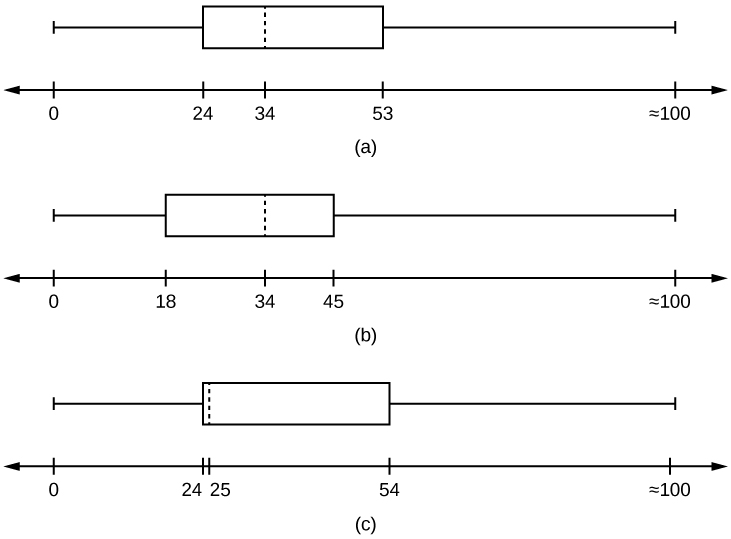
- For graph, check student's solution.
- 49.vii% of the community is nether the historic period of 35.
- Based on the information in the tabular array, graph (a) virtually closely represents the information.
Glossary
- Box plot
- a graph that gives a quick picture of the middle 50% of the data
- First Quartile
- the value that is the median of the of the lower half of the ordered data fix
- Frequency Polygon
- looks like a line graph but uses intervals to display ranges of large amounts of data
- Interval
- also called a class interval; an interval represents a range of data and is used when displaying large data sets
- Paired Data Set
- two information sets that accept a one to one relationship so that:
- both information sets are the same size, and
- each data bespeak in one information prepare is matched with exactly one betoken from the other set.
- Skewed
- used to describe data that is not symmetrical; when the right side of a graph looks "chopped off" compared the left side, we say it is "skewed to the left." When the left side of the graph looks "chopped off" compared to the right side, we say the data is "skewed to the correct." Alternatively: when the lower values of the information are more spread out, nosotros say the data are skewed to the left. When the greater values are more spread out, the information are skewed to the right.

Source: https://opentextbc.ca/introstatopenstax/chapter/box-plots/
Posted by: deeringbefiscure.blogspot.com
0 Response to "what statistics are needed to draw a box plot?"
Post a Comment