

How To Draw Electrical Schematics For House Remodel
Being particular oriented is every bit important to planning as it is to installation. When you program a wiring projection, be methodical: Assess the existing organisation, calculate electrical loads, check local codes, and draw a wiring floor plan.
If yous are just replacing existing devices—changing a low-cal fixture, replacing a faulty switch, or upgrading a receptacle, for example—you seldom need a permit from the local building department. Even so, if you extend or add any circuit, you must pull (or file) a permit.
Most local electrical codes are based on the NEC. When it's necessary to pull a allow, local code authorities will want to corroborate your plans and later inspect the wiring to exist sure it'south correct. Don't short-cutting this process: Codes and inspections protect you and your abode.
Whatever the scope of your project, if yous work on existing circuits, first plow off the ability, test to be sure information technology'due south off, and tag or lock the console.
Inspecting the Fuse Box or Breaker Panel
Past looking at the outside of the service console and wiring that'southward exposed in the basement and cranium, you tin can get a bones overview of the system's condition. If the panel has unused breaker spaces and the wiring insulation is in decent shape, yous can probably continue using information technology and safely add together an outlet or two if there is sufficient capacity. Nonetheless, if the organisation seems dangerous or inadequate, hire a licensed electrician to open up the panel and do a more thorough examination.
Hither's what to wait for:
Start your investigation at the fuse box or breaker panel. You can larn a lot about the condition of the system by examining the exterior of the service box. Examining the inside of a panel or fuse box is best left to a licensed electrician, nevertheless.
Rust and corrosion on the outside of a service box or on the armored cable or conduit feeding it tin can indicate corroded connections within. Faulty connections tin lead to arcing (sparks leaping gaps betwixt wires) and house fires, so have a licensed electrician replace the fuse box or console. Likewise, if yous see scorch marks on breakers or a panel, have a pro examine information technology.
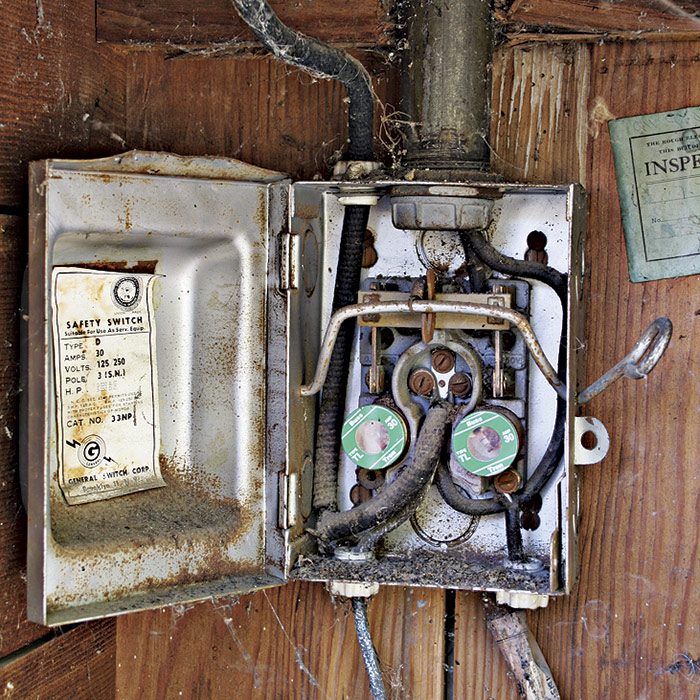
Melted wire insulation is a sign either of an overheated circuit—usually acquired by too many appliances in use at the same time—or of a poor wire connection in which arcing has occurred. In the first case, a homeowner typically installs an oversize fuse or breaker to keep an overloaded circuit from blowing so oftentimes, but this "remedy" exceeds the current-carrying chapters of the wire. The wire overheats and melts the insulation, which can lead to arcing, house fires, or—if someone touches that bare copper wire—electrocution.
An oversize fuse may non melt wires where you tin can run into them, but it may have damaged wire insulation in a place you can't encounter. Take an electrician inspect the electric system. Installing blazon-S fuse socket inserts can forbid overfusing.
"Pennying" a fuse is another unsafe style to bargain with an overloaded circuit that keeps bravado fuses. In this instance, someone unscrews a fuse, inserts a penny or a blank metal slug into the bottom of the socket—a unsafe act in itself—and then reinstalls the fuse. The penny allows current to bypass the fuse and the protection it offers. Here, again, have an electrician examine the circuits for damage to the wire insulation.
Panel covers that don't fit, take gaps, or are missing are dangerous. So, if y'all see covers that have been cut to fit a billow, housing knockouts that are missing, motorcoach confined that are visible when the panel encompass is on, or mismatched components, rent a licensed electrician to assess and correct those problems. Some older brands of panels and breakers, such as Federal Pacific and Zinsco, accept a host of well-documented failures and so should be carefully checked and, where necessary, replaced.
Missing cablevision connectors or unfilled knockouts enable mice and vermin to enter the panel and nest in it, which tin be a fire take a chance. Missing connectors likewise allow cables to exist yanked, stressing electrical connections inside the panel. A missing cablevision clamp may also allow the precipitous border of the console to piece through thermoplastic cablevision sheathing, which could energize the panel (if the grounding of the system is not right) and electrocute anyone who touches it.

A properly grounded panel will take a big grounding wire running from the console to a grounding electrode (which could be a metal underground water pipe, a ground rod driven into the globe, or a Ufer electrode). For the entire electrical organisation to be grounded, there must be a continuous basis wire or other effective grounding path running from each device or fixture to the service panel and, past extension, to the grounding electrode. Common cold-water and gas pipes must also be continued (bonded) to the grounding omnibus in the panel.
A 30-Year Pro's Accept on Rewiring
If the wiring in an older habitation appears to exist sound and in proficient repair (run across the warning signs below) information technology's probably OK to continue using it, fifty-fifty though it may non meet lawmaking requirements for a new installation. If you lot are planning to gut the house completely, it makes sense to rip out all the one-time wiring and completely rewire the house. If y'all're remodeling only part of the business firm, get out nearly of the quondam wiring in place if information technology is audio and spend your coin rewiring the kitchen, baths, and laundry circuits. That will give you more bang for your cadet.
Even so, yous should replace old wiring that's unsafe. If you observe any of these weather condition, the wiring should be replaced:
- Circuits that take been extended improperly, as evidenced by loose connections, unprotected splices, or arcing.
- Knob-and-tube wiring whose insulation has deteriorated or that has been damaged. Also, if knob-and-tube wiring in the attic has been covered with loose-fill insulation or insulation batts, that is a serious lawmaking violation that could atomic number 82 to overheating and fire danger.
- Circuits wired with unsheathed wires (other than properly done knob-and-tube) rather than with sheathed cable or conduit.
Assessing the Condition of Wiring
Cables may be visible every bit they nearly the service panel and equally they run through attics and basements. If there are covered junction boxes, carefully remove the covers and examine the wire splices within—without touching them. You can too turn off power and pull a few receptacles out to better examine the wires.
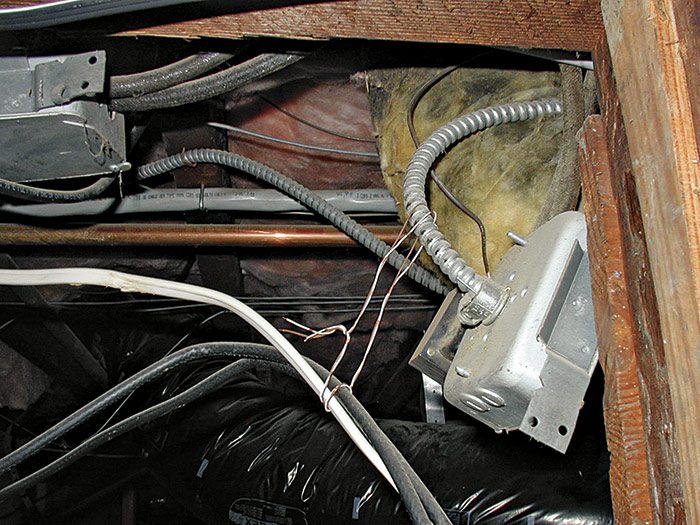
Deteriorated capsule is a potential shock hazard, and so note breakable fiber insulation and bare wire, only avert touching it. If cable sheathing has been chewed on by mice, rats, or squirrels the cable should exist replaced.
NM cable (cable protected by nonmetallic sheathing) must exist stapled within 8 in. of single-gang boxes that don't have cable clamps, and inside 12 in. of other boxes, and supported by stapling or another method at to the lowest degree every 4 1⁄2 ft. (54 in.). A cable running through a drilled hole is considered supported. Sagging wire is hazardous considering it can get inadvertently strained, jeopardizing electrical connections. Also, all boxes must be securely mounted. All NM cablevision entering metallic boxes must be gripped by cable clamps. Unmarried-gang plastic boxes exercise not crave the strain relief of cable clamps, but double-gang (and larger) plastic boxes have integral plastic tension clips that afford some strain relief on cable.
Small-gauge aluminum wiring (ten or 12 gauge) is a fire hazard unless it is correctly spliced to a copper wire with a COPALUM connector or terminated to CO/ALR-rated outlets and switches. If it is incorrectly terminated in a copper-rated only device, the two metals volition aggrandize and contract at different rates each time the circuit is nether load. This can lead to loose connections, arcing, overheating, and business firm fires. Aluminum-to-aluminum splices require special splicing techniques, either COPALUM connectors or another listed and approved method.
Wire splices (whether copper to copper, copper to aluminum, or aluminum to aluminum) must exist housed within a covered junction box or outlet box. Wires that are spliced outside a box or within an uncovered box tin can be a fire chance because of the dangers of arcing. Loose connections not contained in a cover box can easily ignite combustibles nearby because arcs can achieve several thousand degrees centigrade.
Knob-and-tube wiring, although outdated, is usually safety unless individual wire insulation is deteriorated, splices are incorrectly made, or the wiring is overloaded or buried in thermal insulation. Typically, splices that were function of the original installation will not be in a junction box merely must be wrapped with electric (friction) tape and supported past porcelain knobs on both sides of each splice. Nonoriginal splices must be housed in covered boxes. Accept knob-and-tube wiring assessed or modified by an electrician familiar with it; it's quirky stuff. The NEC does non allow knob-and-tube wiring to be buried in insulation.

Knob-and-tube wiring lacks an equipment ground (a divide grounding wire), then it offers no protection should a faulty appliance get plugged into a receptacle. On the other hand, a knob-and-tube organisation is run completely on insulators, a plus. The conductors of knob-and-tube wiring were copper, coated with a thin layer of tin (to protect the copper from sulfur in the prophylactic wire insulation). Uninformed inspectors often fault the tinned copper wire for aluminum wire.
Ungrounded Outlets
You tin can keep using two-slot, ungrounded receptacles on general-use circuits as long every bit the wires are in expert condition and the connections are correctly made. Most new lamp and apparatus plugs are double-insulated and are suitable for use with ungrounded receptacles. However, if yous want to employ appliances or tools with iii-pronged plugs or a surge protector at the location, you must upgrade to a grounded circuit. Putting a ii-pronged adapter on a 3-pronged plug is unsafe.
Assessing a Circuit's Chapters
To recap briefly, electricity, impelled past voltage, flows from the power source. (Amperes are the rate of electron flow.) Along the way (at outlets), information technology encounters resistance and does work. (Watts are a mensurate of ability consumed.) It so returns to the power source, its voltage reduced or spent.
Or, expressed every bit mathematical formulas:
watts = voltage 10 amperes
amperes = watts ÷ voltage
To determine the capacity of a circuit you want to extend, place the circuit breaker controlling the circuit and note the rating of the breaker. If it's a full general-purpose excursion, the billow volition probably exist 15 amp or xx amp. A circuit controlled by a 15-amp breaker has a chapters of 1,800w (fifteen amp 10 120v); ane controlled past a 20-amp breaker has 2,400w.
The full wattage of all loads on the circuit (including the extension) must non exceed these capacities; otherwise, you run a risk overheating wires. To avert overloading, it's a expert idea to reduce the capacity by 20%. For example, fourscore% of 1,800w is ane,440w for a xv-amp circuit; 80% of 2,400w equals i,920w for a 20-amp circuit.
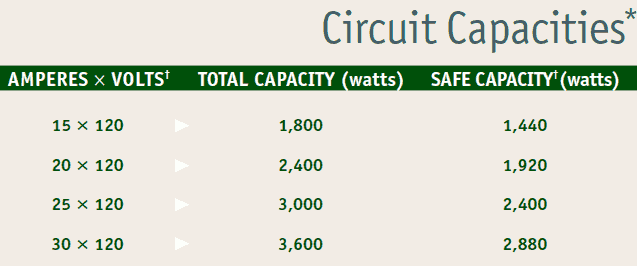
* Condom capacity = 80% of total chapters.
† Amperes multiplied past volts equals watts.
Is the system fairly sized?
If receptacles in your house teem with multiplugs and extension cords, you probably need to add outlets. Merely at that place are more subtle clues: If you blow fuses or trip breakers regularly, or if the lights chocolate-brown out when you plug in a toaster or an electric pilus dryer, y'all may need to add new circuits to relieve the overload on existing circuits. This section will help you figure out whether your organisation has the chapters to do so.
These days, iii-wire service feeding a 100-amp service console is the minimum required by the NEC, and many electricians install 150-amp or 200-amp panels if the homeowners plan to enlarge the house at some bespeak or acquire a lot of heavy free energy-using appliances, such equally electrical ranges and hot tubs. If at that place are only 2 large wires running from the utility pole to the house, they deliver only 120v service. A business firm with 2-wire service probably has a 30-amp or 60-amp main fuse or breaker, which is inadequate for modern usage.
Rules of pollex. The just sure way to know if y'all've got plenty chapters to add together an outlet or a excursion is to calculate electrical loads, as shown in the chart. Only for the benefit of those who wish that an electrician would simply offering an offhand stance of what works most of the time, here are a few rules of pollex.

USING THIS Table
- Foursquare ft. for general lighting load is for the entire habitation including habitable basements and attics.
- NEC requires a minimum of 2 small appliance loads, but it is important to add together small fixed kitchen appliances such equally refrigerator, microwaves, disposals, dishwashers, large range hood, computers, etc.,when calculating this category
- Minimum of one laundry load is required for a unmarried family habitation.
- The need gene calculation is designed to take actual utilise into account (e.g., it is unlikely that all lights and small appliances will be running at one time).
- All large load appliances (high wattage) are added at 100%.
- The concluding load calculation is the minimum. Frequently, increasing capacity has little cost bear upon and is a proficient practice.
- Fuse box service. If you've got a fuse box with a 30-amp or 60-amp master fuse, the best communication we can requite is to upgrade your service. Don't add outlets or circuits until you lot replace the fuse box with a breaker panel. Fused mains are often abused by people trying to bypass its protection, then insurance companies often accuse college premiums on houses with fuse boxes.
- Adding outlets. If y'all have a billow panel with space to add together an boosted breaker, y'all can most likely add a excursion to feed a new outlet or two or more lights. If, for example, you have 3-wire service and a 100-amp main, you lot may have excess capacity.
Safety alert
Don't add outlets to circuits that have ungrounded cable; wires with frayed, discolored, or melted insulation; blackened metallic boxes or other signs of arcing; or aluminum wire (a soft, dull silver) rather than copper. Don't misfile old knob-and-tube wire, which is usually tinned copper, with aluminum wire; the tinned copper has a shiny silver coating on the exterior, but at the cut stop, y'all can see the copper color of the wire.
- Adding a circuit for full general utilise. If there is an unused infinite in the panel, have an electrician determine whether the console can handle another circuit.
- Adding a kitchen or bath circuit. If you want to add together a bath fan or some new light fixtures, and there's space in the panel, have an electrician see if you lot tin add a circuit. Calculation a 20-amp, small-appliance circuit to reduce the load on an existing excursion is smart.

- Remodeling a kitchen. Kitchens are complicated and often full of big free energy users. Employ the nautical chart to assistance you add upwardly the loads. If there aren't many open spaces for breakers, you may demand to upgrade to a larger panel.
- Calculation defended circuits. If y'all demand to add dedicated circuits for heavy-use items such as an electric range (l amps) or a hot tub (60 amps), get out the figurer and exercise the math. general wiring guidelines

Excerpted from Wiring Consummate, 3rd Edition (The Taunton Press, 2017) by Michael Litchfield and Michael McAlister
Available in the Taunton Store and at Amazon.com.

Source: https://www.finehomebuilding.com/project-guides/wiring/planning-an-electrical-remodel
Posted by: deeringbefiscure.blogspot.com
0 Response to "How To Draw Electrical Schematics For House Remodel"
Post a Comment